


Soaking up San Pedro de Atacama
After the cold winds and high altitude of the Bolivian Salt Flats, the desert heat of the haven that is San Pedro de Atacama was very welcome.
We hadn’t booked anywhere to stay yet but managed to find a hostel pretty easily when we got off
the bus. The walls of the hotels were made of mud and that made the rooms quite cool even through there was no air-conditioning.
San Pedro was once a mining town, but has now become a base for travellers who want to explore the area. We spent two nights here enjoying the rustic environment of dirt roads and mud-brick buildings.
There are a lot of tours you can do from here to explore the region but as we had just come from the Salt Flats and were nearing the end of our trip – the budget was pretty tight so we enjoyed a few chilled out days. Our first stop after showering was to get an ice cream and enjoy not feeling cold for the first time since Cusco!
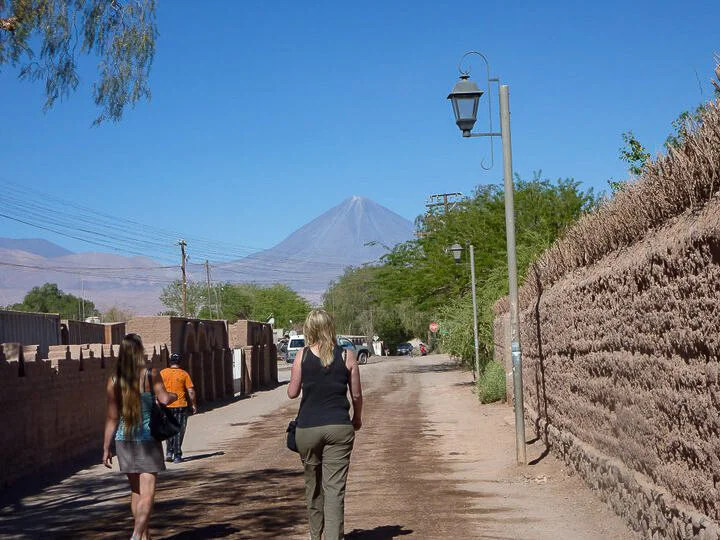
This volcano is a constant backdrop to San Pedro
San Pedro de Atacama is not a big town but there are some nice things to see like the Plaza de San Pedro de Atacama, the church and the meteorite museum. There are nice coffee shops and restaurants in the town where you can chill out – which is exactly what we did.
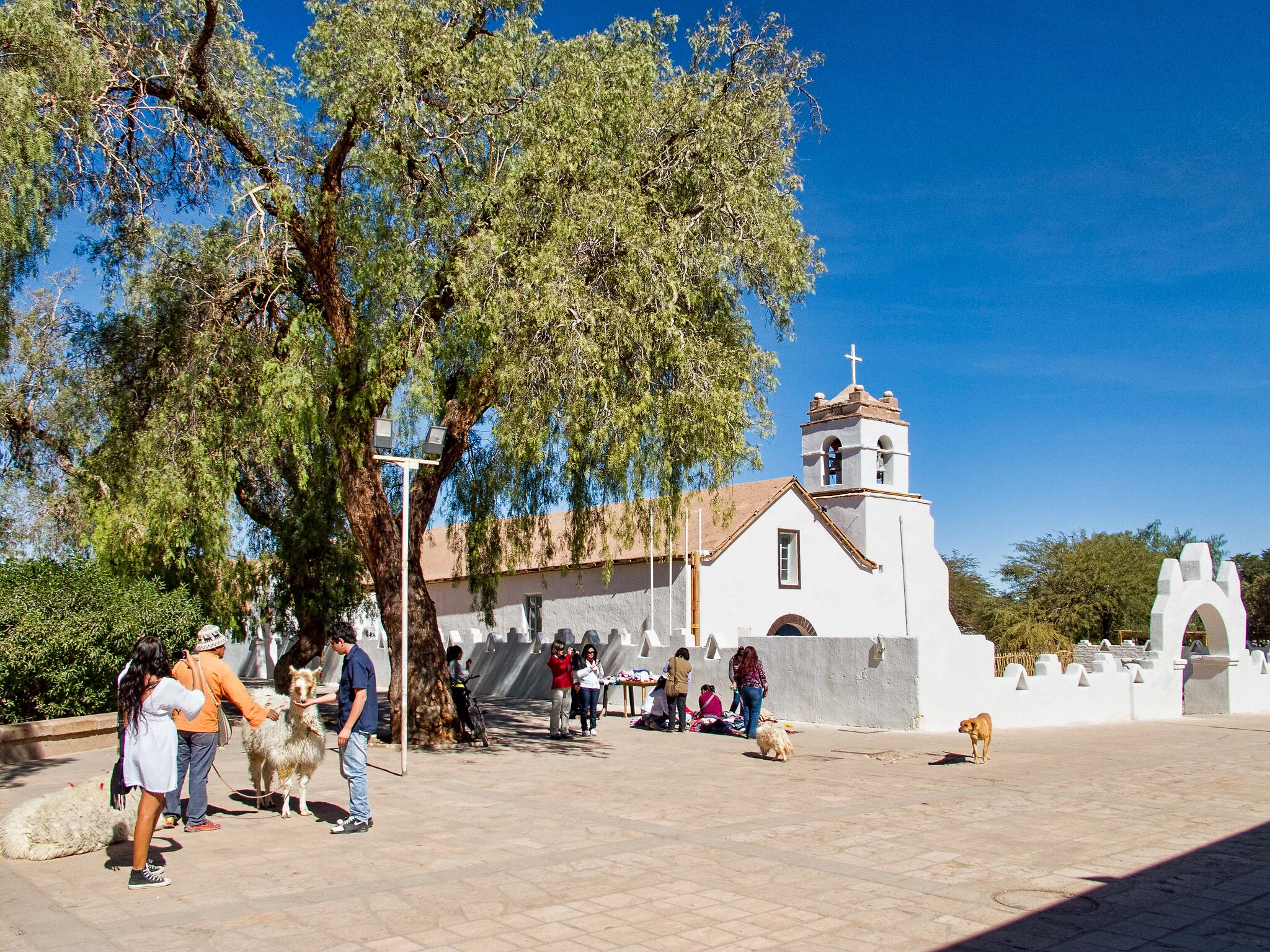
One of the highlights is the gorgeous church near the main square – painted a stark white that contrasts with the rest of the town.
As soon as you get out of San Pedro, there is a strong feeling that you are in the middle of nowhere. Here was my very first experience of what it really feels like to be in a desert. Incredible landscapes but nothing around, no buildings, no power lines, no trees! Just the natural beauty of the place.
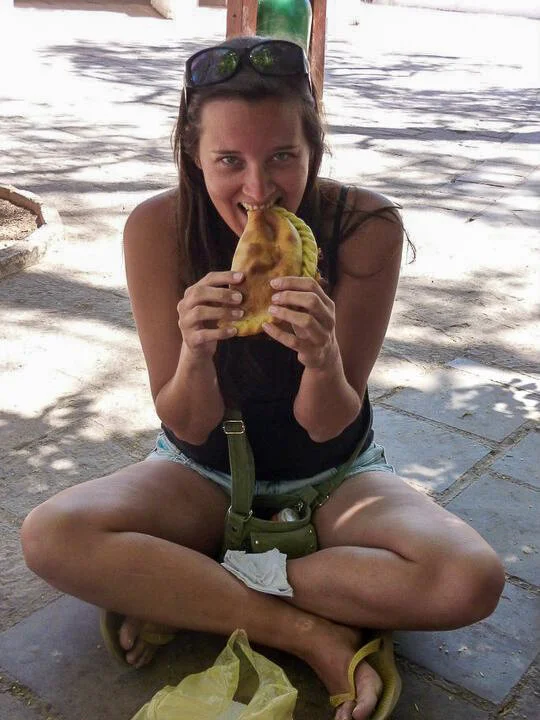
Once of my favourite memories of San Pedro is sitting around eating empanadas the size of my head. I became so addicted to this food that I still make various versions of it at home 10 years later.
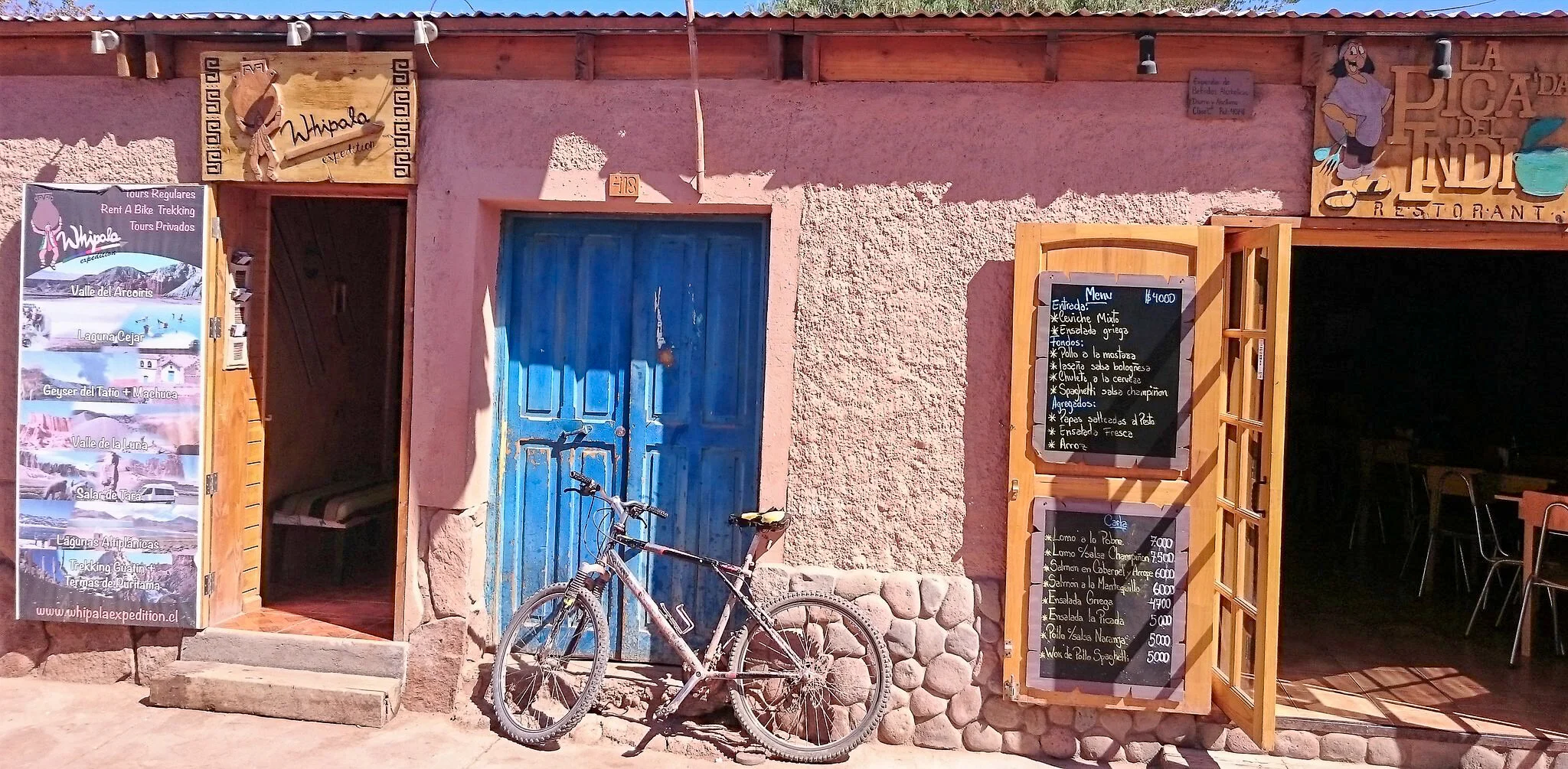
If there’s one thing you do here, it’s to peruse the markets. There are amazing shops lining the streets of town and a bigger artisanal market near the bus station.
Because the town is full of backpackers and travellers, San Pedro definitely has a bit of a nightlife buzz. On our first night here, we had a few drinks well into the night around a fire pit with some other travellers and it was so much fun!
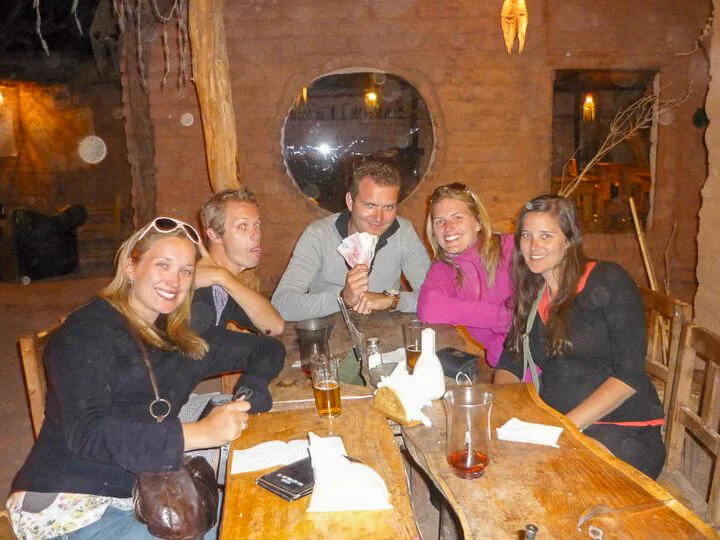
The days are desert-warm but the nights were still quite cool though so when we headed out to the conservatory in the middle of the night, we had to rug up!
After a long relaxing dinner and a good dose of Chilean Cab Sav, our one and only tour from San Pedro started at almost mightnight. We were headed an hour into the desert to an incredible conservatory to see the unpolluted night sky through telescopes and with the naked eye.
On arrival to the designated stargazing spot, we were provided with blankets, and a warm cup of hot chocolate, which definitely helped perk us up – it was freezing!
Away from all light pollution in the expanse of Atacama darkness, the vision is truly incredible. Crisp, clean air and unadulterated, white, bright galaxies. We were able to see a number of astronomical formations, only visible in the Southern Hemisphere, several planets including Jupiter, Saturn and Mars and lose ourselves among the cloudy Milky Way. It was really helpful having the two local astronomers there to explain what all the constellations are.
Book your San Pedro accommodation here.
Because we had an early flight from Calama to Santiago the next day, we decided not to risk a delayed bus and spent our second last night in the mining town.
The bus ride from San Pedro de Atacama (about 100km from Calama) through the desert as the sun was setting was quite surreal. We passed a barren moon-like landscape full of just sand and rocks that seemed to go on forever.
Arriving here and trying to get to our accommodation was probably the only time I have felt unsafe on this whole whirlwind South American adventure. This was also the only hotel we stayed in on the whole trip! Definitely not a place I would stop if I had the choice.

Salar de Uyuni
You have seen the photos on the salt flats with crazy perspectives but there is so much more to a trip from Uyuni across the salt flats.
Think multi-coloured lakes with flamingos, geysers, thermal hot-springs and fascinating rock formations.
The three-day trip that took us from Bolivia to Chile was stunning, arid and hostile all at once.
The landscapes crossed during this off-road journey must be some of the most surreal terrain found anywhere in the world.

After an overnight ride on a local bus from La Paz – small, cold and crowded bus – we arrived in Uyuni around 5am.
After fueling up on coffee and some basic supplies, we piled into a 4x4 with 6 other passengers and our driver. No matter how much I begged, there was to be no driving for me across this crazy landscape.
Our first stop was the rail graveyard. Seeing the hulking iron carcasses of disused trains heaped together and slowly rusting in the harsh elements is mesmerising.

Train graveyard
After taking plenty of happy snaps, we made our way to the original salt hotel - made completely of salt - for lunch.
The next stop is probably my favourite of the trip – and it was on day one!
I cannot resist climbing monoliths and Fish Island rises from salt as far as the eye can see! t’s basically a mountain right in the middle of the otherwise desolate flats, covered in large boulders and cacti.

Fish Island
You do pay a fee to explore the island, and it takes about 45 minutes to walk up and around the whole area but I could have stayed longer!

Before the sun started to set, we took some very amateur shots trying to get the crazy perspective o the salt. I would like to think my camera skills have improved in the last decade. I will just have to come back to test the theory!

Very basic photography skills!
These spectacular salt flats are the largest in the world spreading over 10,582 square kilometres.
The accommodation along the way is in basic dorm-style guesthouses. They call them “salt hotels”, as parts of the building are indeed made of salt. It took a lot of willpower for me to resist licking the wall.
Despite it being freezing – the salt flats sit around 3,656 metres above sea level – our next day starts before sunrise.

These guys are everywhere!

Red Lake
Today is a full day and we stop at Andean lagoons to hang out with hundreds of flamingos, big desert of Siloli where you can see Arbol de Piedra (the rock tree), red Lagoon with more flamingos.

The red lake is known as Laguna Colorada, was by far the largest lagoon we saw. The water is blanketed by red algae giving it a red tint, which paired with the stunning mountain backdrop, salt platform, flamingos, and cacti, made this place absolutely picture perfect.
We also stopped by the green lake. This lake gets its colour from arsenic and other minerals.

Green Lake
We spent the night after this in the middle of nowhere and an attempt to stay outside and watch the sun drop over the desert was abandoned because it was absolutely freezing.

Right before we ran inside to see if I had more clothes I could put on…
Day three saw another sunrise. We woke early to see the ‘Sol de Mañana’ geysers and then headed to the hot springs.
Here you can take a dip in the warm water, formed as a result of volcanic activity from the nearby Polques Volcano.

Hot Springs
After three days of not washing I was keen. With the water hovering around 29 degrees, it was a blissful contrast to the chilly weather outside the pool. The views from relaxing in the waters aren’t half bad either.

Easing into the water
This enthusiasm waned as I had to get out of the water into the cold air (I would say it was minus 5 or close to it..) and get dressed at the back of the car!
The pancakes and coffee lovingly prepared by our driver/guide/chef for the trip were very welcome.

Border crossing into Chile
From here it was on to the border crossing from Bolivia into Chile. Border control here is a tiny hut in the middle of nowhere but the exit stamps where quickly given and we were loaded onto a bus to make the long way down winding roads into San Pedro de Atacama. About an hour into the trip, the bus was stopped, and we were given a thorough inspection before gaining entry stamps.
This trip was roughing it a little, but the experience is definitely worth it. I would 100 per cent include it in your trip if you have the chance


A journey to Machu Picchu
The decade since embarking on the Inca Trail has not diminished the memory in any way. It still remains ones of the most incredible experiences of my life.
I have always wanted to trek to the ancient ruins of Machu Picchu. For me this was definitely about the journey AND the destination. I wanted to experience the wonder of the Andes and not just catch the train to the final destination, and I am so glad I did!
My adventure buddy Mandy and I arrived in Cusco after spending most of the night in Lima airport ahead of a 4am flight. This was probably the worst decision we made on this trip, not realising that lack of sleep and dehydration from those last pisco sours in Iquitos would make the altitude hit us so hard!
The good news is that we booked our classic 4-day, 3-night hike along the Inca Trail through Peru Treks and they required us to pay the balance in person at least 36 hours before the journey started. They do this so that you have some time to acclimate to being over 3,300 metres above sea level.
I only have great things to say about our experience with Peru Treks, from the amazing meals and support on the trail, to the hot tea bought to your tent on early wakeups, to the hired sleeping bags that get donated after 15 uses, to our amazing and knowledgeable guide – Luis. Peru Treks have a reputation for treating their porters – all local Peruvians – well which was a big part of why we decided to book with them.
We explored Cusco, tried to hydrate, and had to cancel a day trip to the Inca archaeological site in nearby Ollantaytambo because while I was suffering faint nausea and headaches, Mandy was violently ill. Our helpful hostel called a doctor and we managed to get her well enough to start the trek after a day of relative rest.
Like any good trek, the days start early!
On our first day, we left Cusco around 5.30am and travelled by bus for about 2.5 hours to Urubamba for a snack, final bags check and for me, the purchase of a beautiful wooden walking stick that I carried around South America but couldn’t take home to Australia.
The trek starts at kilometre 82 - which is of course 82km from Cusco. Here we strapped on our packs, crossed a river and headed gently up to the Andes.

The first day is considered the easiest by many, but my mild altitude sickness was lingering and I found myself really struggling. Because of this, my memories of the day are actually a bit of a blur.
I do remember being amazed at our porters whizzing past and having our tents all set up and ready to go by the time we got to camp. These guys are pretty much athletes – carrying all that gear upskill is a skill!
My notes tell me we passed through some small villages on our way to camp and meandered through a fort. There are a lot of ruins along this trek and our guide was great at explaining what all the different uses were. This is where the adage about it being more about the journey than the destination really rang true for me. I had no idea there would be so much history to complement the incredible vistas along our hike.

I was very early to bed with little to no appetite on that first night. Between that and the exertion, I found myself using a spare luggage strap as a belt to keep my hiking pants up the next day!
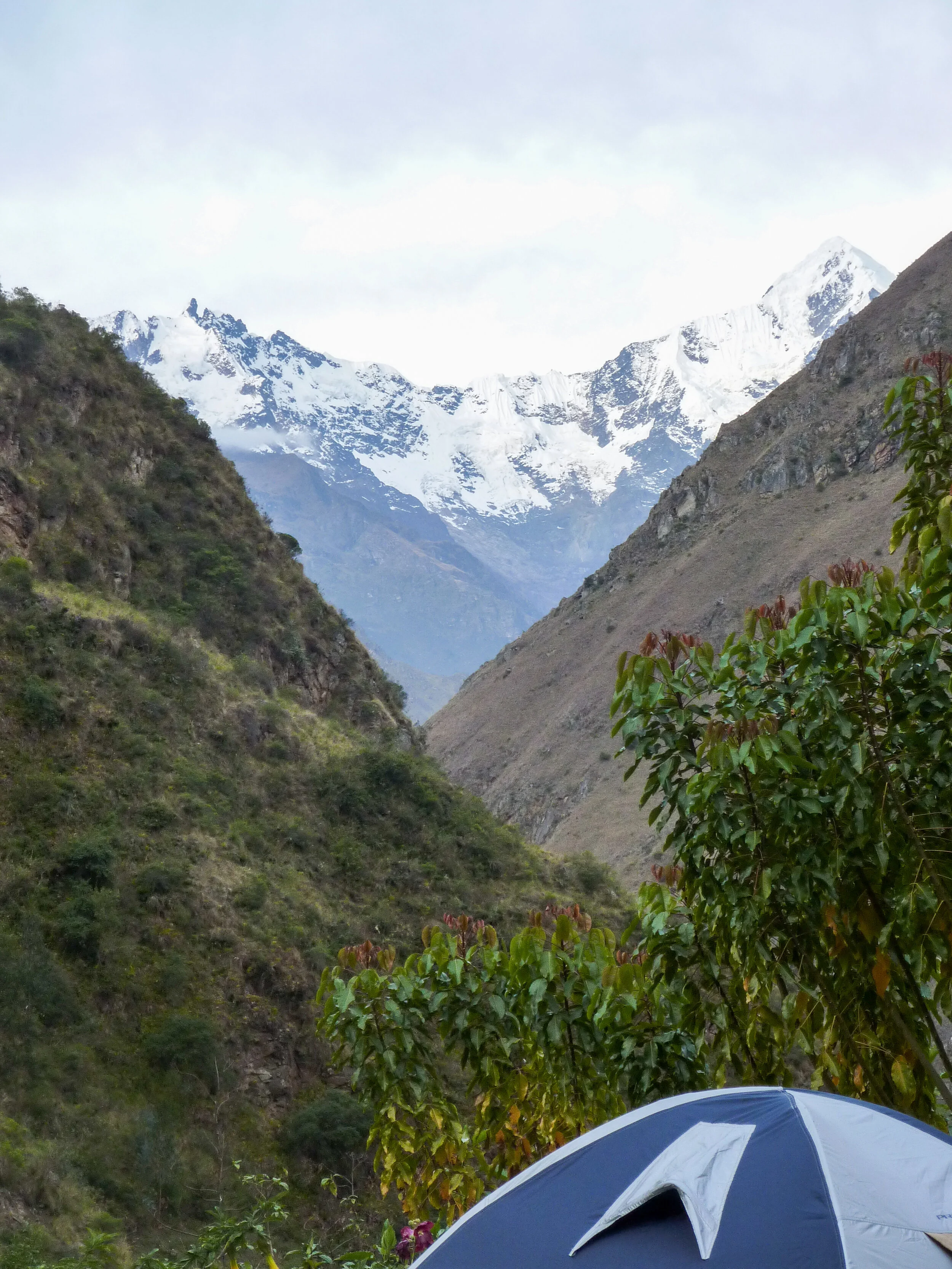
Camp on the first night
The total distance of day one was 12km, so very achievable but did not prepare me at all for day two…
Most of day two is completely uphill and at times, the ascent can feel never ending. Towards the end of the day, you reach Dead Woman’s Pass which is 4,200 metres above sea level. To get here, Mandy and I had to take it really slowly and were definitely bringing up the back of the pack! We would take turns setting ourselves small goals. Like when we get to that big rock, we can have a rest.
It was challenging – we walked uphill for about seven hours straight - but rewarding and I practically bounded down to camp after reaching the top – loving the walk high, sleep low concept. I honestly have no idea how I had any energy left that day to make the 90-minute descent.

The name of the pass isn’t actually because us women all die trying to get there (which was in the back of my mind during some of the tougher moments), it was given the nickname because of the shape of the mountain resembling that of a dead woman lying on her back.
The landscape along the way was stunning and almost made up for all the out-of-breath moments. Mandy and I do not have a lot of photos from the top of the pass as we were just so shattered when we got there.
Because we were pretty slow today, the sun was already starting to set as we arrived into camp, tucked into a hearty and delicious three course meal and passed out in our tents.
The 12km of day two was definitely the hardest day and mentally, thinking about trekking 15km the next day after that brutal ascent was challenging.
The good news is, day three covers so much beautiful ground and there is quite a bit of descent, so you feel energised from all that extra oxygen!

We came across different scenery that we hadn’t previously seen so far, including cloud forests and terraced landscapes. The scale of the work the Incans did on this trek still blows my mind.
This day provided probably one of my favourite views ever. When climbing the hill to leave one of the ancient sites – Runkuracay – you look back and can truly see the scale of the ruins but also the breathtaking dominance of the surrounding mountains.

Runkuracay
We also travelled through an Inca tunnel carved into the rock, after which the stone path hugged the mountainside, with nothing but a steep valley on one side. I don’t have the words to convey how tiny this moment made me feel.
To finish the day, there are a lot of large stone stairs on the way down to camp. Me and my little legs were grateful for the walking stick and I know some of the older members of our group really felt this in their knees. It was really a great equaliser talking to everyone about our aches and pressure points because the journey is different for everyone.

Taking off the boots at night is an amazing feeling
Our campsite on night three overlooked a massive valley and we all enjoyed a beer soaking in that view knowing we had a very early start the next morning.

The porters bought us tea and breakfast before 4am and it was all systems go to pack down and get moving to reach the Sun Gate – the entrance to Machu Picchu.
There are several different tour companies all travelling basically the same journey so there is a queue of people waiting for the gates to open. Nothing bonds you like sitting in the dark in the dirt.
The idea is to reach the gate at sunrise and I have heard the view is spectacular but on our arrival after walking in the dark for about an hour and a half with head torches, we were surrounded completely by fog. It was like being inside damp soup!

While that was disappointing, we were lucky that the fog cleared as we walked down to the site itself and we got taken on a tour of Machu Picchu and then from 11am were able to explore freely on our own for a while before heading down to the town of Aguas Calientes and a late train and bus back to Cusco.

By mid-morning the site it bustling with day trippers so, against my legs better judgement, we decided to ascend once again to higher and more remote parts of Machu Picchu where there were no other tourists – namely the Inca Bridge.

Inca Bridge clinging to the cliff
This trail is built into the cliffs, dropping off the side of sheer mountainside. You can’t actually walk on the bridge for safety reasons but it is still a very impressive sight to see.
Back at the hostel, I washed away four days of dirt on my skin but the memories of this adventure will never fade.
Find your accommodation here.

Adventuring in the Peruvian Amazon
When we planned our short but jam-packed trip to Peru, Bolivia and Chile. Mandy and I each picked one must-do that we built the itinerary around. My pick was the Inca Trail, but I am so glad Mandy picked the Amazon.
We started our journey here and while it was not without its challenges getting there, it was an incredible, unforgettable experience that still sticks with me a decade later.
The adventure started waiting at the baggage carousel in Lima International Airport. My flight from Sydney arrived about 30 minutes before Mandy’s came in from Toronto near midnight and we were so excited to see one another that it took a while for us to realise that Mandy’s bags never showed up.
After a stressful wait for the next flight to come in, the bags arrived and we dashed through customs and to the domestic terminal and just made our 5am plane to Iquitos.
The drama didn’t stop there. After being up most the of the night, I fell asleep on the short flight but awoke suddenly as the plane veered sharply and I looked out the window to see the ground directly below me as the plane was on its side! It turns out there was unusually heavy fog and the pilot had misjudged the landing. An announcement came over the loudspeaker to say they were going to make another attempt but if that failed, we would be returning to Lima – not how we wanted our holiday to start.
Luckily, the second landing attempt was successful, and it was first of several flights on this trip that ended with a round of applause from the passengers.
Iquitos is an island city in Peru that can only be reached by plane or boat. It takes about seven days to get down the river depending on the season and many people who live there have never left.
The town itself feels like it is stuck somewhere in the 1950’s with a dinner that would fit in in any American movie I have seen of the era.
Once arriving and removing all our warm clothes as the humidity started to seep in, we were loaded onto a boat and travelled two hours along the famous Amazon river to our home in the jungle fort the next three days.

Relaxing in our very necessary gumboots provided by the lodge.
On arriving at Amazonas Botanical Lodge, the relaxation pretty much set in. So much so that I ended up having a mid afternoon nap before we headed out for a short walk with our guide – a trained shaman – who showed us all the different medicinal plants that can be found in the jungle.

We also made friends with the resident toucan, Simon the tortoise and some very friendly macaws.

You would think after all the travelling we would be in for an early night, but off on a nocturnal tarantula hunt we went.

Luis sourcing a snack from the jungle.
I was surprisingly relaxed exploring the jungle at night, mostly thanks to my confidence that Luis would keep us safe. Tarantulas were spotted and then it was definitely time for bed.
Our individual hut was open to the elements but covered in netting to keep the bugs out. It was nice to fall asleep to the sounds of the jungle.

We rose before sunrise the next day to head down to the river and watch the show. The word amazing doesn’t even begin to cover the experience of seeing this wild world awaken from a custom-built tower for the very best views.

After breakfast, we visited a local tribe to see how life in the Amazon really is but my absolute highlight of the day was meeting my spirit animal on the hike there.
We saw two sloths literally just hanging off some small trees and I could have stayed there for hours if I weren’t worried about being left behind! The jungle is truly full of amazing wildlife. We almost lost Mandy a few times chasing butterflies into the distance.

The day was capped off at a sugar cane distillery where make rum and molasses. It is all done without any electricity and tastes delicious.

Walking to the boat from the distillery. In the wet season these stairs are completely submerged.
The icing on the cake of our first full day in the Amazon was a boat ride back to the lodge at sunset. I still struggle to find the words to describe the feeling of contentment seeing all the colours and just realising where we were.
The next morning, we were supposed to walk to somewhere called the Giant Tree but it was cancelled due to some serious jungle rain but by late morning the sun came out and we visited a local village where both Mandy and I had a fabulous time playing soccer with the school children.

Soccer fun!
After lunch it was time to leave the jungle and head back to Iquitos but not without one more lasting memory as we stopped the boat to watch some pink-nosed dolphins fishing. They were a little elusive for the camera but the memory still remains.
I may never make it back to see the mighty Amazon again but I hope all the memories never fade.


Getting lost in Fez
In the Moroccan town of Fez, the word Labyrinth is brought to life like nowhere else I have seen.
There is a reason Mandy and I got lost more than once exploring the marvellous Medina of Fez. Inside the walls of the old town, there are no cars but that is because the paths are too narrow. At some points they are even too narrow for a bicycle and you will definitely meet the occasional donkey!

Wandering the streets and alleys, it is hard to believe that some 90,000 people still live in the Fez Medina.
Before exploring the city itself, we stopped at a viewpoint overlooking Fez. This really gives a great perspective and you can see how vast the Medina is.

The real Fez experience all starts when you stroll beneath the famous blue gate of Bab Boujeloud, it feels like you are being transported back in time. This is the oldest part of the city and is officially a UNESCO World Heritage Site.
Navigating the Medina is adventure on its own and on our first day, we had a guide take us around to see all the sights.

One of our first stops was the Bou Inania Madrasa. This is a former Islamic school that can now be explored by tourists. Inside there are bright, elaborate mosaics and incredible wood carvings decorating the walls and floors and a fountain as the courtyard centrepiece. This is the city’s only building still in religious use that non-Muslims are permitted to enter. There are still parts of the building where women are not welcome.
We spent some time exploring the heart of the Medina and taking in all the smells and sounds. Here you will find everything for sale. Handwoven Berber rugs, leather slippers in every shade conceivable, intricate brass lamps, spices and bottle after bottle of Morocco’s argan oil.
Fez is famous for its leather tanneries, so of course we made a stop there and of course I bought a pair of pink leather sandals that I still have seven years later!
The best views of the tanneries are from the shops surrounding them. Be warned – the smells is really strong and I do recommend taking the offered sprigs of mint to sniff as you explore. The views of all the stone tubs make it all worth it though.
The tanneries here still operate in much the same way they did in medieval times, with manual labour and natural dyes. The various animal hides are first soaked to break down the tough leather, loosen excess fat, flesh, and hair that remain on them. The hides are then soaked in another set of vats containing a mixture of water and pigeon poo. The poo contains ammonia that acts as softening agents – I think that is what really contributes to the smell!

I found it amazing that so many vibrant colours are created from natural dyes. Saffron making a bright yellow and mint making a nice green for example.
On the second day, we decided to explore on our own and it certainly resulted in some interesting adventures.
I was determined to find the henna souk I had read about in the hotel and get a henna tattoo.
After meandering around in the heat for a while and even sitting in on a school class of young children – very randomly – we found the tiny souk amid stalls selling pottery and surrounded by gnarled trees.

What it took a few moments to understand is that henna is sold here but not applied. The stall owner arranged for a local woman who spoke only Arabic to apply the traditional tattoos for us.
This involved following a man through myriad alleys and walkways to her home – and me without my trail of lollies to retrace our steps with. GPS really won’t help you inside this Medina, even some locals who have lived here all their lives still have trouble navigating around certain areas.
We were ushered upstairs in the home and communicated via charades and my basic French with the man who I could only guess as a husband!?
She offered us mint tea as she created beautiful designs on our ankles and hands, but it did take a while to feel comfortable in this environment and looking back, this probably wasn’t the safest thing we had done.

Of course, the story doesn’t stop there. On leaving, we were just shown the door and we found ourselves in a very unfamiliar and residential area of the Medina and with no idea how to get out. We just started walking… and got completely lost!
Soon we happened upon a fresh food market, thinking we must be going in the right direction. We were wrong. A few passers by mentioned how unusual it was to see tourists in this part of the Old Town.
Eventually someone offered to show us the way out – for a fee of course. This is something that will happen a lot as you wander around.

We got lucky and our ‘guide’ actually showed us areas that many people don’t go and was super knowledgeable about the history. We tipped him pretty well for as a thank you.
Fez is a place I would definitely visit again because there are still corners of the old city to be discovered and getting lost is half the fun.
Enjoy the labyrinth of souks, colours, mosques, tagine and beautiful chaos around every corner and book your own stay here.

Sleeping in the Sahara
The drive from Fez was hot with a few stops along the way. The first stop was Imlil – sitting at 1800m above sea level, this town is known locally as ‘Moroccan Chammonix’ A strange sight to see and a little touristy for my like.
The next stop was much more fun as we spent some time with Barbary macaque (monkeys) in a forest. Many happy snaps were taken.
The last 15km into Merzouga along dry gravel roads in the middle of July was probably the hottest I have felt!
After a long day driving from Fez, we arrived at Auberge Les Dunes D´Or in Merzouga.

Mandy enjoying the cool of the pool.
The hotel sits on the edge of the Sahara Desert, overlooking sand dune but with a very welcome pool to cool off in.
After a restful night, it was time to get out and experience what we came here for – time in the vast Sahara.
The morning was spent exploring the desert in a couple of land cruisers. We ran up sand dunes, experienced some incredible and unexpected landscapes and had tea in a Berber tent with some locals which was an amazing experience.

In the afternoon it was time to saddle up on our camels to spend a night sleeping in the Sahara. We were each assigned a camel, I named mine Prince Ali but his actual name was Amshalah. We set out so late in the day because it was the middle of summer. In the cooler months, they leave into the desert a bit earlier.

We rode over sand dunes for just over an hour into the desert as the sun was sinking over dunes in the distance. Such an other-worldly experience that I am so grateful for. I am also grateful the ride wasn’t much longer – camels are really not the most comfortable way to travel!
Riding a camel is kind of like lolling around on a large barrel with legs, constantly feeling like your saddle might be slipping off…

As we rode along expertly led by our guide (with our other guide for the whole trip Momo, following behind on foot), we had time to admire the beauty of the Sahara. The light grains of sand gracefully danced in the breeze. Soon we reached the highest peak to see our overnight camp below.

The spacious tents were positioned to face each other, with colourful seating in the middle, arranged in a circle to gather around a fire.
After dismounting the camels and letting them rest for the night, the more energetic amongst us decided to run up the nearest sand dune to try and catch the last of the sunset. I chose this moment to sit in camp and soak it all in.

This is probably the one regret I have on this trip. Who knows when I will ever have the chance to run up a sand dune in the Sahara again?
Dinner at camp was an amazing tagine under the stars and the brightest moon I have ever seen. This was followed by a drum circle and singing before we all decided to pull our mattresses out of the tents and sleep under the stars. The summer heat had not abated at all so sleeping outside seemed the better option anyway!

Me and Prince Ali
This truly was a once-in-a-lifetime experience and I had trouble falling asleep as I didn’t want to miss a moment. I was mesmerised by the many, many stars which shone so brightly.
Rising early the next morning, we rode back to Merzouga and washed all that Sahara sand off with one last dip in the pool and set out on our next Moroccan adventure.


The Windy City of Africa: Essaouira
If there is one thing that can be said of Morocco, it is that it is vast country with diverse pockets.
One of those pockets is the sleepy port city of Essaouira.

Sprawling on the Atlantic Coast of Morocco, this town has been described as a cross between North Africa and the Mediterranean and is also colloquially called the ‘windy city of Africa’ by many.
While enjoying about 300 days of sunshine, for much of the year, the wind blows so hard in Essaouira that it is definitely a windsurfers paradise but a sunbakers nightmare. That does not make it any less beautiful or worthy of a visit. Particularly on hot summer days, that salty wind makes for a refreshing change from the heat of the desert and packed cities.
Unlike many other parts of Morocco, Essaouria is not jam-packed with must-see sights, but I found it a fantastic spot to spend a few days exploring and relaxing.

This is the city that spawned my love of coloured doors and I could watch the brightly painted blue boats rolling in the harbour for hours.
After waking with the call to prayer (played over loudspeakers placed conveniently right outside my window), my days here started with a walk or a run along the 2km beach. Watching the kite-fliers and locals playing football on the seemingly endless curve of sand is a great distraction. For those more active, windsurfing is a very popular activity here.

The beach is seemingly endless
While I did jump in the water once, that Atlantic Ocean was a bit cold for this Aussie!
Breakfast and lunch were usually found somewhere in the Medina. Unlike Fez, the medina here is very easy to navigate and I didn’t get lost once!

You can’t walk very far without finding a crepe stand if you need a sweet snack.
As you wander through narrow alleyways lined by tall whitewashed buildings there are still plenty of twists and turns, but it is nothing like the chaotic maze of the bigger cities. The centre of the medina is Place Moulay Hassan, a big square where the cafés are perfect for people-watching with a view of the ocean and there are many artisan shops and local argan oil co-operatives to browse.


The old town is protected by imposing 18th-century ramparts that once were used to protect the port from pirates. The seawalls are an excellent location to take a stroll and admire the gorgeous ocean views – or for Game of Thrones fans, relive the scene where Daenerys meets the Unsullied Army in season three.
In the port, you can walk along the seawall to have a better view of the entire harbour and a little further, a fantastic view of the long stretch of beach. Walking through the port, you can’t help but be mesmerised by the famous blue wooden fishing boats, called Floukas.

After watching the fisherman return each day with their catch, seafood is the obvious choice for dinner. This was also a nice change from the many chicken tagines and kofta eaten all over the country, but the more traditional Moroccan fare is still available and delicious.
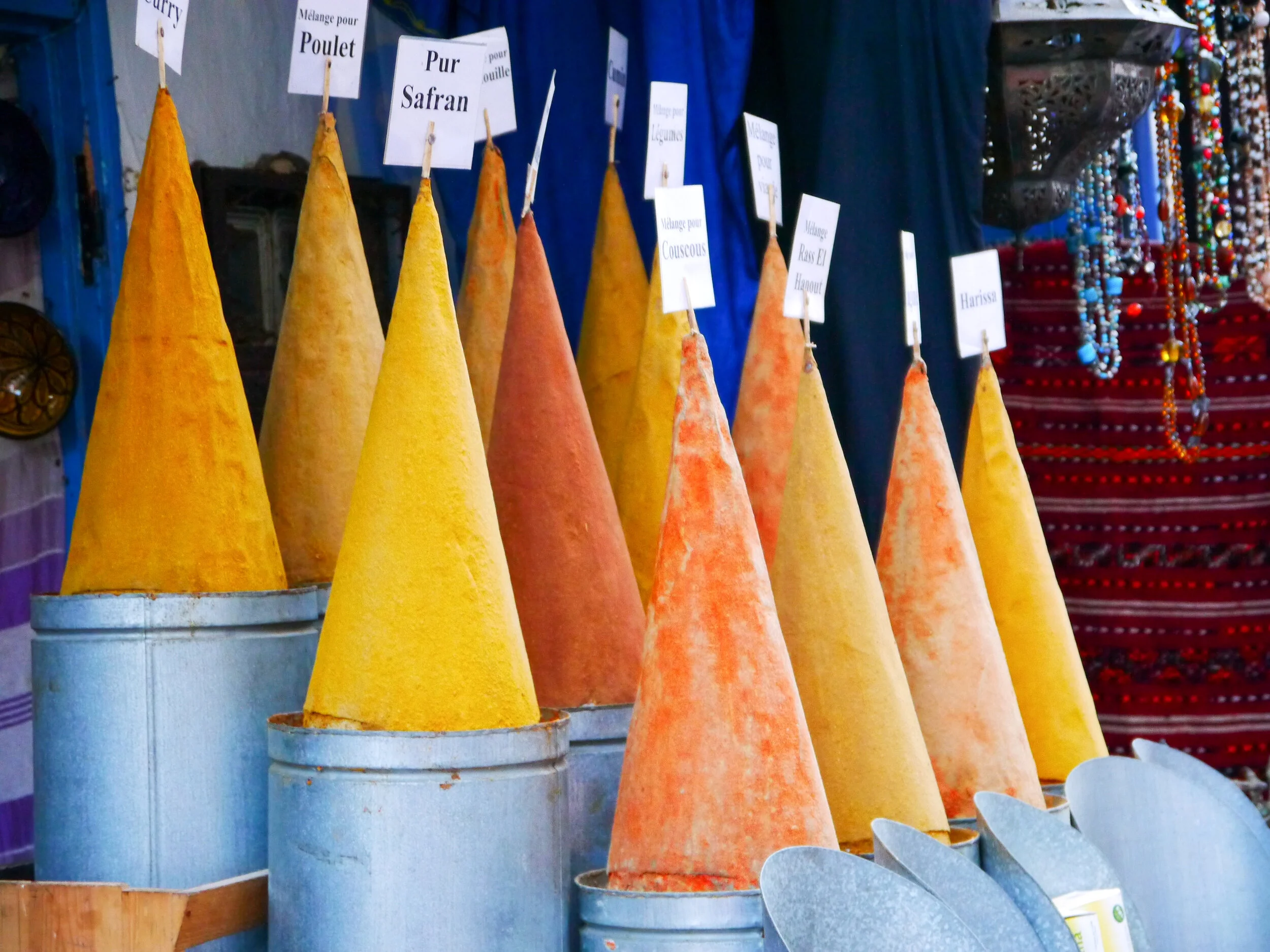
Spices abound in Essaouria
The only way to end each is to watch the sun set over the Atlantic. Nature puts on a spectacular light show you can catch from the ramparts or even just down on the beach.
I would be wary of some of the hawkers down on the beach at dusk, we were offered what I am pretty sure were hash cookies at one point and managed to score some new (somewhat unwanted) henna tattoos from some women on the beach. They only spoke Arabic and just started drawing on my arm then expecting payment. Thankfully, it faded quickly with the help of a bit of nail polish remover.

Henna attack!
One of my favourite aspects of this seaside town is that you can literally walk everywhere – not haggling with aggressive taxi drivers for a couple of days was a wonderful reprieve.
Essaouira has a very laid-back vibe and you won’t find the opulent hotels of Marrakech here but that is all part of its charm. The people here are also very chilled out, making it the perfect break in a hectic trip around Morocco. I am so glad we had a couple of nights here even though it can be visited as a day trip from Marrakech.
Book a Moroccan adventure here!

One of the best best doors I have seen!

The Roman ruins in Morocco: Volubilis
When we booked our trip to Morocco, I knew there would be a lot to see and do but I didn’t expect to visit the edge of the former Roman empire.
Not far from Meknes – a city with an imperial past and stunning gates – you will find Volubilis.
This UNESCO-listed site dates back to before the Roman times and it is one of the country’s most significant archaeological sites.

Surrounded by mountains and fields, Volubilis was once a Berber settlement, before later becoming a strategic outpost of the Roman Empire.
It is the ruins of the Roman empire you come here to see. What struck me was how vast the site is and that is with only a fraction of the buildings properly exposed.
For perspective, the site today is about 20 hectares, half of its original size. Excavation teams are still working to uncover the other half.

It is believed nearly 20,000 people once called this city home!
According to historians, the remains of Volubilis remained essentially intact until an earthquake in the mid-18th century caused it to crumble. Stones, marble, and other building materials were then scavenged for buildings in Meknes.
Remnants of ancient palaces complete with stunning floor mosaics that have stood the test of time. Among the ruins, you will find statues, a bathhouse and an aqueduct, making this an impressive site to visit.

The ruins seemingly appear in the middle of nowhere. This is probably why Volubilis is still considered one of the Roman Empire’s most remote outposts.
Volubilis was a wealthy city and a centre for olive production, the oil was then exported to Rome together with wheat and olives.
The sites to look out for are the Mosaic test of Hercules, arch of Caracalla and the temple of Jupiter.

Given this is Morocco, don’t be surprised if you spot a donkey or two hiding among the ruins and sprawling olive groves at Volubilis.

We travelled with a tour group but have heard stories that the entry is hard to find on your own – and we had the added bonus of the guide explaining a bit more about the story behind the ruins which really brought the history to life for me.
If you visit the site solo, near the entrance, you will find official guides offering services in many languages.
We spent the best part of two hours exploring the ruins and didn’t even cover half of the site. Pack water and a hat, especially if you are visiting in summer.
Even if you aren’t stopping at Meknes, Volubilis is easily accessible from Fes as well and from my point of view, it is definitely worth the trip.
